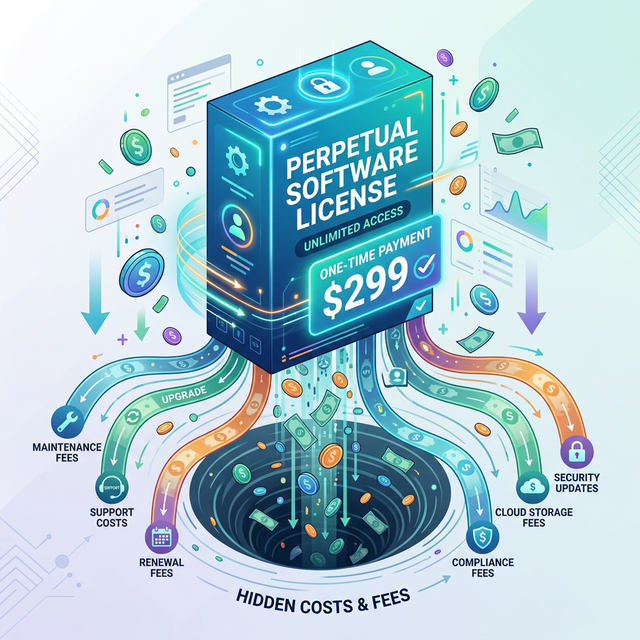
The Hidden Costs of Perpetual Licenses in Document Viewer Solutions
The Hidden Costs of Perpetual Licenses in Document Viewer Solutions
Why a “one‑time” price tag can become a perpetual drain on your engineering budget – and what CTOs and SaaS founders can do differently.
Introduction
In practice, that promise rarely holds up. After the contract is signed, engineers start to feel an unseen erosion of budget: extra maintenance contracts, scaling penalties, integration workarounds, and hidden SDK royalties.
This article unpacks those hidden expenses, quantifies their impact, and introduces a subscription‑based, collaborative alternative that aligns with modern DevOps workflows. If you’re a CTO or SaaS founder looking for a genuine return on investment (ROI), keep reading.
The Hidden Cost Breakdown
1. Maintenance Margins
| What’s advertised | What you actually pay |
|---|---|
| One‑time fee per seat | • Version‑lock fees – Major releases often require a separate maintenance contract (15‑20 % of the original price). • Feature‑only patches – Security patches are free, but any functional enhancements (new PDF standards, accessibility updates, OCR improvements) are billed per incident. |
Why it matters:
A perpetual license locks you into the version you bought. When the vendor releases a new major version—say, .NET 8 support or PDF‑2.0 compliance—you’re forced to sign a maintenance add‑on or continue using an outdated, potentially non‑compliant viewer. The cost quickly morphs from a CAPEX expense into an ongoing OPEX burden.
2. Scalability Snags
- Seat‑based rigidity: Licenses are tied to named users. Adding 10 engineers means purchasing 10 additional seats at the original price—no discount for volume.
- Penalty tiers: Exceed the licensed headcount and the vendor may enforce a “over‑usage” surcharge, sometimes 2× the per‑seat rate.
Real‑world impact:
A mid‑size SaaS startup grew from 30 to 70 developers within six months. Their document viewer spend jumped from $30 K to $80 K almost overnight, not because the product got more expensive, but because the perpetual model couldn’t flex with their headcount.
3. Integration & Opportunity Cost
Most perpetual‑license viewers ship as stand‑alone binaries with limited extensibility:
- No native Git hooks or branch awareness.
- No collaborative editing mode; each developer works in isolation.
- No out‑of‑the‑box rendering of API specifications (Swagger, OpenAPI, AsyncAPI).
Consequences:
| Cost | Example |
|---|---|
| Developer hours | Teams spend weeks building custom wrappers, writing scripts to pull the viewer into CI/CD pipelines, or maintaining a parallel documentation pipeline. |
| Technical debt | Work‑arounds become fragile, increase bug surface, and slow down feature delivery. |
When developers are forced to “reinvent the wheel,” the true opportunity cost can exceed the license price by several hundred thousand dollars over a product’s lifecycle.
4. The SDK and Royalty Minefield
Many document viewers are built on a software development kit (SDK) that developers embed directly into their SaaS offering. The SDK license often includes:
- Base SDK fee – Usually covered by the perpetual license.
- Distribution royalties – A per‑instance or per‑seat royalty payable when the viewer is delivered as part of a SaaS product.
- Compliance clauses – Failure to remit royalties can trigger legal action, fines, or forced removal of the viewer from the service.
Bottom line: What begins as a fixed “one‑time” cost becomes a variable liability that scales with your revenue and user base.
A Smarter Path: Subscription‑Based Collaborative Documentation
Instead of fighting hidden fees, many forward‑thinking companies are adopting a single, collaborative platform that bundles viewer capabilities, version control, and API‑spec rendering into a predictable subscription.
Key Benefits
| Feature | Perpetual License | Subscription Platform |
|---|---|---|
| Real‑time collaborative editing | Not included; separate tools required. | Built‑in, unlimited collaborators. |
| Native API spec rendering (Swagger, OpenAPI, AsyncAPI) | Add‑on or custom development. | Included out‑of‑the‑box. |
| Git integration (commits, branches, PRs) | Manual scripts or third‑party services. | Direct integration with full audit trail. |
| Pricing model | Up‑front CAPEX + hidden OPEX (maintenance, scaling, royalties). | Predictable OPEX; pay‑as‑you‑grow. |
| Update cadence | Paid per major release; lag time between releases. | Continuous delivery, all updates included. |
Cost Comparison (5‑Year Horizon)
| Scenario | Up‑front Cost | Hidden OPEX (maintenance, scaling, royalties) | Total 5‑Year Cost |
|---|---|---|---|
| Perpetual License | $30 K (initial 30 seats) | $5 K/yr (maintenance) + $10 K/yr (scaling) + $2 K/yr (royalties) | ≈ $150 K |
| Subscription Platform | $12 K (first‑year subscription) | $13 K/yr (incl. support, updates, scaling) | ≈ $65 K |
Numbers are illustrative based on typical mid‑size SaaS workloads.
The subscription model converts unpredictable spikes into a transparent, operational expense that aligns with SaaS financial planning. It also eliminates the need for separate integration projects, freeing engineering capacity for product differentiation.
Conclusion
Perpetual‑license document viewers may look enticing on the balance sheet, but the hidden maintenance contracts, scaling penalties, integration overhead, and SDK royalties can erode—or even reverse—the perceived savings. For CTOs and SaaS founders who prioritize predictable budgeting, developer productivity, and compliance, a subscription‑based collaborative platform offers a clear, future‑proof alternative.
Ready to stop the surprise fees?
- Get a free, no‑commitment cost analysis at doconut.com/pricing.
- Download the “Hidden Costs of Perpetual Licenses” whitepaper for an in‑depth financial model.
- Schedule a 15‑minute demo with our product specialists and see the platform in action.
Transparency, collaboration, and continuous updates should be the baseline—not a hidden cost. Choose the model that lets your engineering team focus on building value, not patching licenses.